The Official Website is currently under renovation. You can read only Minsik’s article here. Find more details on the Official Instagram.

ㅤㅤSilent Spring
ㅤㅤㅤㅤㅤㅤPublished 16 November 2022
“She was the very first person to knock some of the shine off modernity… she was the first to tap into an idea that other people were starting to feel.”
Bill McKibben
an environmentalist, author, and journalist
The Ideas of the relationship between human and nature
Today, many think about the impact our actions have on the planet. In the 21st century, we are the generation who feel guilty about using disposable products and chemical products. However, if you ask when this idea became possible, the answer is not easy. We do not know exactly where this view we are now following came from.
Since ancient Greece had an animistic worldview, philosophers at that time equated living and inanimate objects, minds and matter. However, that view was dualized into humans and nature based on Plato’s dualism. From then on, until the second half of the 20th century, nature was thoroughly objectified by humans. Of course, Spinoza argued in his book called “Ethics” that nature includes humans as a part of nature. But it was not the mainstream view at the time.
On the other hand, Rachel Carson’s argument made many people follow her. In her book, published on September 27, 1962, we can find a clue that where the view came from.
The explorer of nature

Rachel Carson was born in 1907 in the town of Springdale which is 18 miles up the Allegheny River from Pittsburgh. In her early life, She had many opportunities to explore nature on her family’s 65-acre farm. In 1925 she entered the University of Pennsylvania for women. And she changed her major from English to biology during her sophomore year in college.
After graduating from university with honors in 1929, she became a summer scholarship student at the Woods Hall Marine Biology Research Institute, where she was able to experience the sea for the first time in her life. After a scholarship program, she attended graduate school for zoology at Johns Hopkins University with a scholarship and completed a master’s degree in 1932.
In 1935 When her father Robert Carson died suddenly, she was forced to take care of the family. At the urging of her undergraduate biology mentor Mary Scott Skinker, she settled for a temporary position with the U.S. Bureau of Fisheries, writing radio copy for a series of weekly educational broadcasts entitled Romance Under the Waters. After gaining a large audience through the radio series, she was given the opportunity to work full-time at the Bureau of Fisheries. Through writing, she worked to establish a wonder of nature, and she finally garnered a good reputation with the public by publishing books “Under the Sea Wind”, “The Edge of the Sea” and “The Sea Around Us”.
Life-changing events
Carson was building a promising reputation as a writer for her delicate depictions of nature. But two events about the pesticide changed Carson’s life entirely. The first was the operation to eradicate fire ants, conducted by the United States Department of Agriculture in 1957 and 1958. Although the fire ants did not cause much damage to human life, the US Department of Agriculture indiscriminately sprayed insecticides to eradicate fire ants. Several biologists, including scientists have reported damage to large wildlife in areas where pesticides have been applied. However, the US Department of Agriculture refuted that the damage to wildlife was not caused by the spraying of pesticides.
The Second was the Massachusetts government’s plan to use large amounts of DDT to kill mosquitoes in the northern coastal area in the summer of 1957. But the pesticide was carried by the wind and spread to nearby towns, including Duxbury. Unfortunately, this insecticide did not kill mosquitoes and killed birds, bees, and small bugs. Carson’s old friend Huckins, who lives in Duxbury, protested to the state government, but the state rejected Huckins’ claim that DDT was not harmful even if sprayed on humans.

In January 1958, Huckkins wrote a letter of protest in the Boston Herald and sent a copy of the letter to Carson. After reading this letter, Carson herself, who investigated the use of pesticides at the time, was greatly surprised, and she thought that she should deal with this issue directly.
Silent Spring
Carson received numerous attacks on the book that had to be canceled even before it was published. Because she covered the shortcomings of pesticides and the lobbying of chemical companies. Despite constant attacks, she values the public’s right to know and publishes her book on schedule.
In Silent Spring, She begins with a fairytale not an expertise about the pesticide. It’s a story about a peaceful village where the birds don’t sing for one day. Through her long training in writing, she knew how to best communicate with the public. She explained the negative changes in the ecosystem and the arrogance of humans in pursuit of convenience and the consequences. Carson especially argued that humans should not seek to dominate nature through chemistry, in the name of progress.
Silent Spring’s effect
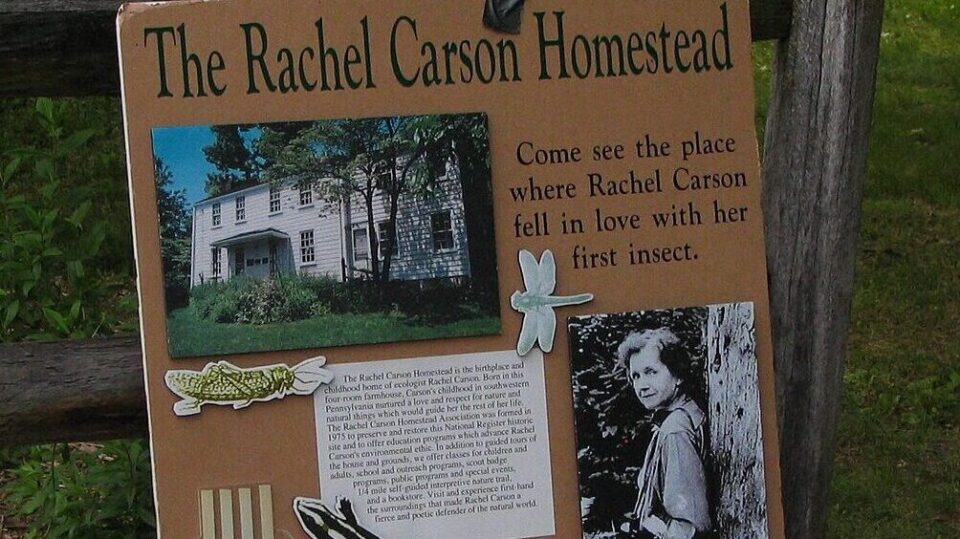
After the book’s publication, the US government began an investigation into pesticides. And one year after the book’s appeared, the government published a report titled “The Use of Pesticides”, which recommended a phaseout of persistent toxic pesticides. The changes brought about by Silent Spring continued to occur gradually after Carson’s death on April 14, 1964.
On April 22, 1970, the first Earth Day was held in the United States. In the same year, on the initiative of President Nixon, the Environmental Protection Agency was established. Two years later, in 1972, Finally, the United States banned DDT for domestic sales. And environmental laws like The Clean Water Act and The Endangered Species Act have been passed in the United States.
The value she wanted to spread
She wanted to protect the nature she loved. Therefore, instead of writing a hard to understand report for experts, She decided to write a book for the public. Because she believed that the more people who agreed with her opinion, the more likely it would be to solve the problem we were suffering from now.
Her efforts also show us that even one individual has the power to change the world. Visible or invisible environmental pollution is still in our lives. We still have two options. Whether you choose to ignore or solve it, it is forever tied to your life. Because it has always been our problem.
🕰️ Timeline
Click through the arrows to explore
📝 Academic Paper
Interested in the full details? Click below to read the complete academic paper.
About the Author
Minsik Choi
Minsik Choi studied Philosophy at the University of Seoul and is a first-year student at Ca’ Foscari University’s Master of Arts in Digital and Public Humanities.
Her main area of interest is environmental philosophy, semantic web technology and artificial intelligence.